|
|
"So I pretended to be using the airbrush and improved my brush technique"
“Sebastian Kruger has continued the development of his victims’ faces because they did not have enough courage to do so themselves.” –Chlodwig Poth |
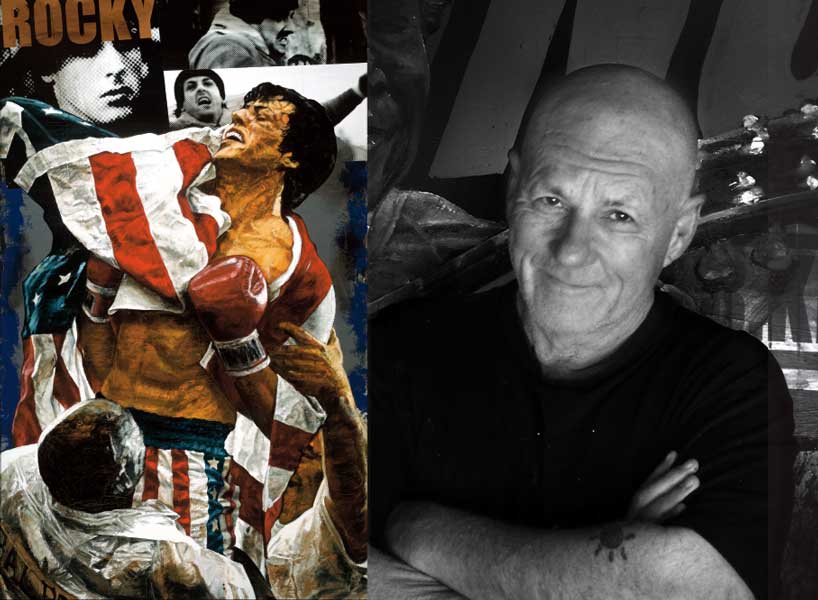
| It’s impossible to express the facts more consistently. Sebastian Kruger. Shooting Star among the world’s caricaturists has no intention of being easy on his victims when skewering them on his drawing board. And he shows no mercy either for the subject of his portraits or for the viewer. Sylvester Stallone seems to have been hammered in all of his Rock fights in the course of a few minutes: Jack Nicholson’s forehead looks like it is going to split, and the poor prince of Wales’ crown won’t fit at all.
The Rolling Stones seem to be the long-time favorites of the artist, who lives near Hanover, Germany. Keith Richards’ face is cut into deep furrows; Ronnie Wood’s hair seems to explode and Mick Jagger is slobbering on his Microphone. No star is safe from being pierced by Kruger’s sharply pointed pencil. The German artist’s paintings can be found inside, and on the cover of renowned magazines world wide, including Stern, Cosmopolitan, L’Espresso and USA Today. Also he is consistently turning out innumerable poster and publicity illustrations. It’s high time for us to feature the artist and his work AAA: Anyone who is doing these kinds of high- quality illustrations today must have stated his drawing practice early in childhood, right?
SK: Yes, I began painting rather early. I must have been around three years old when the undoing began. My father is an architect: maybe that is the reason for my artistic learning’s. Of course, his kind of work is very different. He never painted, except when in collage.
AAA: Many parents like to keep the first little doodles their children make, and they seem very special later in life, while remembering the sweet childhood days…
|
|


|
SK: Oh yes. Just recently I rediscovered some old pictures I did my first tries must have been some futuristic cars, the science fiction kind of thing. Maybe I should show them to a psychoanlyst or maybe I’d better not. I always thought I had started with drawings of Donald Duck, as my father used to drag me to all kinds of Disney movies. After that I always tried to draw Donald from memory, but I never managed, as there was some kind of movie running through my head and Donald never held still long enough to be drawn. It drove me to despair! I must have wasted a lot of paper.
My parents did not buy me comic books, so I always went to the newsstand to memorize a single picture, then hurried home and tried to paint it. When I was missing some detail, I returned to the newsstand immediately…
AAA: What about school? Did the art classes turn out to be your all-time favorite, or did you have to cope with conflicts? |
 |
|
SK: The latter, no doubt. I have always been drawing, and was not interested in brushes and colors. At best I would use some felt pens. The lines were important to me, not superb watercolor gradations. As soon as we started using those silly painboxes and large brushes in our art classes, I completely failed and was graded 4 [merely sufficient] on my next annual report card.
AAA: You should have bribed the teacher with some naughty little caricature!
SK: that would have been one possibility. I did caricatures of some teachers anyway, but not to show them up. Their faces had to have something special. Later on my abilities were recognized, at least in the artistic field. After having repeated a grade twice, this ability was the only reason I could stay in school and finish it. Art classes were rather boring for me. It might sound strange, but they were below my standards. That is the reason I never did my homework, so all I got on my annual report card was a grade 2 (failing).
AAA: Well you finally managed to graduate and finish your studies. |
SK: Yes. My father would have preferred if I had started in an advertising agency, but one of his good friends managed to convince him to let me do it, although there’s no money in art I really had to choose between making money or continuing my studies. I had never fancied writing 20-page reports and, honestly, those things did not make much sense to me, so I left the university. |
I had just met Mr. Becker, who was able to arrange some jobs for me. I seized the opportunity, to my parents’ great disappointment. But my time at the university had not been wasted–at least I learned a great deal about color theories, etc.
AAA: Did you start as a caricaturist immediately?
SK: No. I was thrown into cold water and had to work with acrylic paint, although I had specialized in oil. My first jobs were covers and inlays for videotapes. Illustrations., such as the A-Team video cover, are from that time. Horrible–it had nothing to do at all with the art I had learned. But advertising does make money–the only reason why I still do it today. It was then that I got myself an airbrush.
AAA: …and you never used it, right?
SK: True. I hope your readers won’t be shocked, but I simply could not get used to that thing. I almost wrecked my am carrying the compressor all over Hanover. And nobody was able to help me and explain the thing to me–I am no technician, you know. Neatness and cleanliness are not my style, so I am better off with a brush.
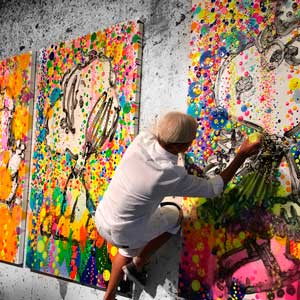
So I pretended to be using the airbrush and improved my brush technique in a way that, at first glance, my work did not look as if it had been airbrushed. Nobody realized it at first. And at that time, the heyday of the airbrush in the mid ‘80s, incredibly bad work was produced for movie and video posters. Everybody tried to imitate Casaro. The Sylvester Stallone arm that he did for Over the Top Must be the most copied arm in history, and the result became worse with each successive copy.
AAA: Can you imagine using the airbrush once, and for what might you use it?
SK: Never say never. But I remember one of my pictures in which the background had to be oversprayed with the airbrush. It did not harmonize with the rest of the picture; maybe I would have to change my technique. But I certainly do not miss the airbrush technique. Somehow, I always managed to get the result I wanted, even if I had to paint in many layers.
AAA: in the meantime, we would presume that most of the jobs you get are for caricatures, correct?
SK: Yes, that’s right. As I mentioned before, there are some advertising jobs every now and then that have nothing to do with caricatures, but that does not happen very often. I regard myself as an illustrator specialized in portraits, and not merely as a caricaturist. I do a lot of work apart from caricatures, but when the customer requires them, I do them. |
|


|
AAA: Do your customers leave the work up to you, or do they set certain limits?
SK: It depends on the customer. I just finished a job for playboy. The job was to depict Boris Becker. They gave me no more details. Well, I began experimenting once again and am looking forward to the reaction. Maybe they won’t print it, but that would be stupid.
AAA: Why wouldn’t they print it? Could Boris Becker cause problems himself?
SK: Yes, he could. In two cases, people I portrayed have filed a lawsuit–one of them was Steffi Graf. They did not sue me, but the editors who had ordered the caricature. As an artist, I am not in danger, but people may protest magazine covers. I have no clue how the whole thing turned out, as the issue is already on sale. |
On the other hand, such things make your name known to the public. Maybe some people feel exposed by my paintings, because I show some of their inner feelings; who knows
AAA: That’s one thing that distinguishes your work clearly from other caricatures–they often seem like a whole life frozen in one portrait. In order to do so you must be able to identify with the person portrayed, know their biography and even more. How do you prepare yourself?
SK: Of course, I try to get to know as much as possible about the person. I read biographies, watch movies, study books and photographs. There’s nothing worse to me than to be asked to portray a person I do not know. I’m given only a photograph and the request “please do a caricature.” In such cases, the only thing I can do is exaggerating some details of the physiognomy. But usually I need more–more photographs, more information. The more I know about “the object,” the better the picture gets.
AAA: you may already have answered the question many readers might be asking themselves: Do you use one of the modern computer programs that allow faces to be contorted in different ways?
SK: Heavens, no! Of course not. There’s no way of doing a good caricature that way! There is so much more to it than just enlarging a nose, tearing the forehead and replacing the eyes. You need much more background than that. |
|
 |
AAA: Does Sebastian Kruger refuse to draw certain people?
SK: Not in general. It depends on the context. I would even draw Nazi war criminals in a reasonable situation. I would voluntarily supply pictures for an article in which they are really done away with. I would support that kind of thing; it is a good opportunity to let loose all kinds of aggression. But it really depends on the context.
AAA: As an illustrator, you seldom get any reactions from the people who view your work. How important to you are things like public reactions and opinions about your work? |
 |
|
SK: Very important. Unfortunately, there’s no direct contact as there is with musicians. A pop star can judge his success by the number of records he sells, and on tour he is in direct contact with the audience and gets applauded. As an illustrator, you tend to overlook all these things. At exhibitions, I seize the opportunity to watch people’s reactions to my work. And when someone comes up to ask for an autograph, it really lifts you up and strengthens your ego.
AAA: During the last few years you have made yourself a name, and your order books are packed. Don’t you fell tempted sometimes to concentrate on free art and sell originals?
SK: That would certainly be great, and I am slowly getting to the paint at which I recognize the necessity of selling originals. But I could not make a living out of it. Taxes just kill you. And I won’t move to another country, as I am too lazy for that. A certain amount of taxes is okay, but sometimes it is real hard. You just start thinking that you might be well off, and then the next letters come pouring in from the tax authorities.
But making big money is not the most important thing in my life. It would be an unbelievable luxury to earn enough money with the things I love doing to buy myself a house and be only my own. Get real rich? Well, there may be some possibility, but it will take a long, long time Don’t forget that I do not serve the masses with my work. And I can not jump on the merchandising bandwagon, as my victims’ lawyers would surely kick me in the butt for that |
AAA: But we have seen T-shirts with your pictures on them.
SK: Either it is an agreed-upon deal with licensed fees, etc., or, as in many cases, a copy. Some people are audacious enough to simply copy one of my pictures and have it printed on a T-shirt, and others just imitate my style. I have no problem if people imitate and copy for the practice, but as soon as they try to make money out of it, it is not okay any more. Oh, does that cover of Airbrush, Art + Action, February 1995, ring a bell for your?
AAA: Well, that is indeed one example. We usually take care to publish only “original” pictures, but even we are not aware of all the pictures in the whole wide world–sorry. |
You once did an exhibition together with Ronnie Wood, who also paints himself. And as far as we know, you are quite close to Keith Richards.
SK Right. Ronnie Does portraits, too, and so the idea of joint exhibition emerged. But it rather suffered from the Rolling Stones’ popularity. Keith, well he is very special one. We usually meet once a year and I always send him a small present for his birthday. We get along rather well with each other.
AAA: So he accepts the way you depict him?
SK: Oh, yes. You have started this article with a quotation of Chlodwig Poth. Well, Keith has the courage! He is always ahead of me. Each time I see a recent photograph of him I start thinking, “Damn, he cleared off again without asking me!’ He’s got one more wrinkle without talking it over with me. Sometimes he jokingly calls me Dr. Frankenstein. Keith will always stand by it, but he tends to prefer other works of mine, such as those of the other band members.
AAA: Getting back to our discussion of your technique, you prefer to work on illustration board measuring 28 x 39 inches. On average, how long does it take you to do a picture of that size? |
|
 |
SK: It depends. Some of them take only one day, while others take four or five days to finish. I am a rather impatient kind of guy, and when I get a kick out of it I paint like one possessed.
AAA: Okay. Imagine it were Saturday, you get THE IDEA and there’s no board or other paintable surface around. What would you do?
SK: You knew about this one beforehand! Well, I take one of the pictures I don’t care for that much and use the back. That’s what happened with the picture of Arnold Schwarzenegger you are obviously referring to. I had the idea and literally no illustration board available. So, without further ado, I painted it on the back of an existing Tom Waits portrait.
AAA: Do you do thorough sketches, or do you start by putting down colors immediately?
SK: That differs, too. Often I take a thick felt pen do a sketch n the original surface. This sketch will then disappear under all the layers of acrylic paint (mostly from Liquitx, Lascaux, and Schmincke). But you have to work rather quickly to achieve good gradations. You need some training. In most cases I start with the nose as the center of the face and go from there. My wife once advised that all those steps should be captured on photographs, to show how I build my pictures. Maybe I’ll do that sometime.
AAA: Great idea, and we will be unselfish enough to put the necessary space at your disposal to show our readers how you create such an illustration. Thank you for consenting to this interview–we hope you will continue to be as successful as you have been for quite some time! |
|